How Much Does a Website Cost in 2026?
A straightforward guide to website pricing — what you should actually expect to pay for a landing page, business site, online store, or custom web application in 2026.
The Quick Answer: What Does a Website Cost?
If you are searching for "how much does a website cost," you have probably already encountered the standard non-answer: it depends. And while it genuinely does depend on scope, design, and functionality, that does not mean we cannot give you concrete numbers.
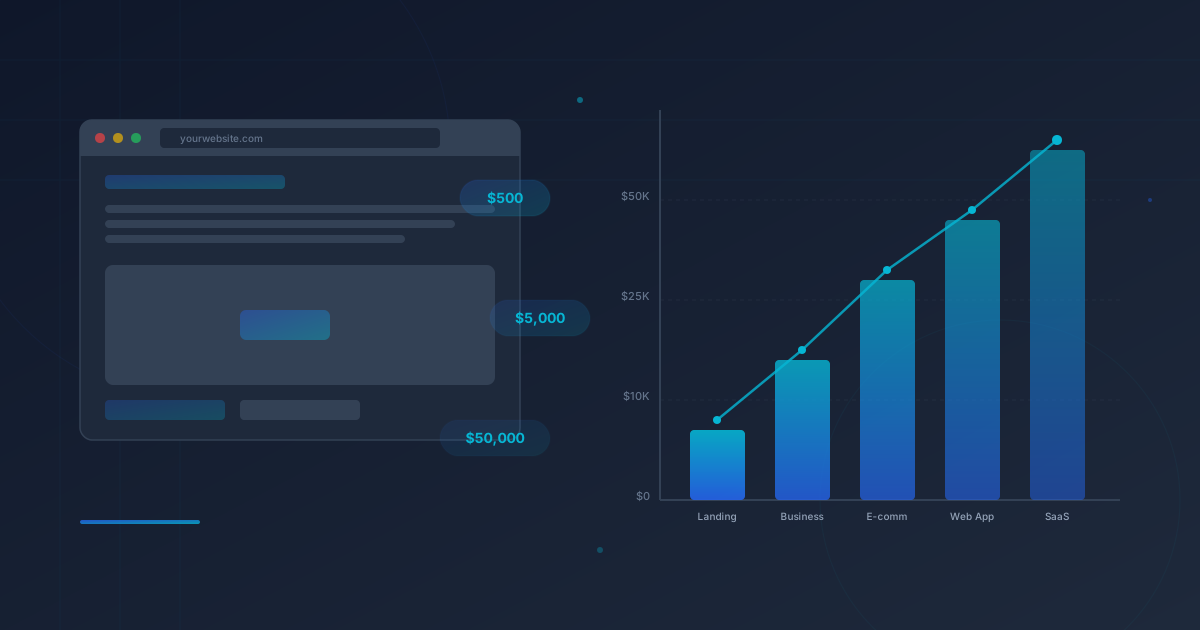
Here is the short version. In 2026, a simple landing page runs $500 to $2,000. A multi-page business website typically falls between $2,000 and $10,000. E-commerce sites range from $5,000 to $25,000. And custom web applications start around $10,000 and can exceed $50,000 for complex platforms.
Those ranges are wide because every project is different. A five-page site for a local bakery is a fundamentally different undertaking than a 200-product online store with multi-currency checkout. The rest of this guide breaks down exactly what drives those numbers so you can estimate your own project with confidence.
7 Factors That Determine Website Cost
Before diving into specific price ranges, it helps to understand the variables that move the number up or down. These seven factors account for most of the variation in web development pricing.
1. Number of Pages and Content Volume
A five-page site takes far less time than a 50-page site. Each page requires design, development, content creation, and testing. More pages also mean more navigation planning, internal linking, and SEO optimization. If your project involves hundreds of product pages or blog posts, expect the content architecture alone to add meaningful cost.
2. Design Complexity
Design is one of the biggest cost drivers. A site built from a pre-made template (with brand customization) can cost a fraction of a fully custom design. Custom design means wireframes, mockups, revision rounds, and pixel-level attention to detail. The choice between template-based and custom design can easily swing the total by $2,000 to $5,000.
- Template-based design: $300 - $1,000 — a pre-built theme adapted to your branding
- Semi-custom design: $1,000 - $3,000 — template foundation with significant customization
- Fully custom design: $3,000 - $10,000+ — every element designed from scratch
3. Functionality and Features
A static contact page is cheap. A booking system with real-time calendar sync, automated emails, and payment processing is not. Each feature adds development hours, testing time, and ongoing maintenance complexity. Common features and their approximate cost impact:
- Contact form with validation: $100 - $300
- Blog or news section: $300 - $800
- Multi-language support: $500 - $2,000
- User accounts and authentication: $800 - $2,500
- Online booking or reservation system: $1,000 - $4,000
- Payment processing integration: $500 - $2,000
- Custom admin dashboard: $1,500 - $5,000
- Third-party API integrations (CRM, ERP, etc.): $800 - $3,000 per integration
4. Platform and Technology Stack
WordPress sites are generally the most affordable because of the massive ecosystem of themes and plugins. SaaS platforms like Shopify or Squarespace reduce upfront cost but introduce monthly fees and platform limitations. Custom-coded sites (using PHP, React, Next.js, Laravel, or similar) cost more upfront but offer complete control, better performance, and unlimited scalability.
5. SEO and Performance Optimization
Basic SEO — proper meta tags, clean URLs, XML sitemap, mobile responsiveness — should be included in any professional website build. But competitive keyword targeting, content strategy, schema markup, and Core Web Vitals optimization add to the scope. Expect to budget $500 to $2,000 for thorough on-page SEO beyond the basics.
6. Content Creation
Many quotes do not include copywriting or photography. If you need professional product descriptions, blog posts, or brand photography, budget separately. Professional copywriting runs $50 to $200 per page. Photography sessions typically cost $300 to $1,000. Stock photos are cheaper at $5 to $50 per image but feel less authentic.
7. Timeline and Urgency
Rush projects cost more. A site that would normally take six weeks but needs to launch in two will require overtime, parallel workstreams, and schedule reshuffling. Expect a 25-50% premium for significantly compressed timelines. Conversely, flexible timelines sometimes open the door to better rates.
Website Cost Breakdown by Type
The following breakdown reflects realistic 2026 pricing for professional web development. These are not rock-bottom freelancer rates or enterprise agency premiums — they represent what a competent, quality-focused team charges for solid work.
| Website Type | Price Range | Timeline |
|---|---|---|
| Landing Page | $500 - $2,000 | 1 - 2 weeks |
| Business Website | $2,000 - $10,000 | 3 - 8 weeks |
| E-Commerce Store | $5,000 - $25,000 | 6 - 14 weeks |
| Web Application | $10,000 - $50,000+ | 2 - 6 months |
| Enterprise / Custom Platform | $50,000 - $150,000+ | 6 - 18 months |
Landing Page ($500 - $2,000)
A landing page is a single-page (or few-page) site designed to drive one specific action: a signup, a purchase, a phone call. It is the most affordable website type and ideal for product launches, event registrations, or lead generation campaigns.
What is typically included:
- Responsive design optimized for conversion
- Clear call-to-action sections
- Contact or signup form
- Basic SEO setup
- Mobile and tablet optimization
- Analytics integration (Google Analytics, Meta Pixel)
At the lower end ($500 - $800), expect a template-based design with your branding applied. At the higher end ($1,200 - $2,000), you get custom design, A/B testing setup, and copywriting assistance.
Business Website ($2,000 - $10,000)
This is the most common type of professional website. It represents your company online, communicates your services, and generates leads. Most small and medium businesses fall into this category.
What is typically included:
- 5 to 30 pages (Home, About, Services, Portfolio, Blog, Contact, etc.)
- Content management system (CMS) so you can edit content yourself
- Custom or semi-custom responsive design
- Blog or news section
- Contact forms with email notifications
- SEO optimization and Google Analytics
- Social media integration
- SSL certificate and basic security
A straightforward 8-page business site with a quality template design typically lands around $2,500 to $4,000. Once you add a blog, multi-language support, custom animations, or CRM integration, the price moves toward $6,000 to $10,000.
E-Commerce Store ($5,000 - $25,000)
E-commerce sites are inherently more complex because they involve product management, shopping cart logic, secure checkout, payment gateway integration, shipping calculations, and order management. The price depends heavily on catalog size and feature requirements.
What is typically included:
- Product catalog with categories, filters, and search
- Shopping cart and secure checkout process
- Payment gateway integration (Stripe, PayPal, credit cards)
- Inventory management system
- Order tracking and email notifications
- Discount codes and promotional pricing
- Customer accounts and order history
- Mobile-optimized buying experience
- GDPR/privacy compliance
A smaller WooCommerce or Shopify store with under 100 products typically falls in the $5,000 to $10,000 range. Larger stores with thousands of SKUs, advanced filtering, multi-currency support, or ERP/warehouse integrations can reach $15,000 to $25,000.
Web Application ($10,000 - $50,000+)
Web applications go beyond content presentation. They solve specific business problems through custom software: think booking platforms, SaaS dashboards, client portals, or internal business tools. This category involves significant backend development, database architecture, API design, and security considerations.
What is typically included:
- Custom-built application tailored to your business logic
- User roles and permission systems
- Dashboard with reporting and analytics
- API integrations with third-party services
- Data processing and automation workflows
- Security layers (encryption, authentication, audit logs)
- Scalable architecture for growth
- Ongoing maintenance and support plan
A reservation management system might cost $12,000 to $20,000. A multi-tenant SaaS platform with billing, user management, and API access could run $30,000 to $50,000 or more. The complexity of the business logic is the primary cost driver in this category.
Hidden Costs Most People Miss
The development price is not the full picture. These ongoing and ancillary costs catch many first-time website owners off guard.
Domain and Hosting
A domain name costs $10 to $20 per year for common extensions (.com, .net). Premium or country-specific domains can cost more. Hosting ranges from $50 to $150 per year for shared hosting, $200 to $600 for VPS, and $500 or more per year for managed hosting with guaranteed uptime and support.
Ongoing Maintenance
Websites need updates — security patches, CMS updates, plugin compatibility fixes, content changes, and performance monitoring. Budget $300 to $1,200 per year for a basic site, or $1,200 to $5,000 per year for complex sites and web applications. Neglecting maintenance leads to security vulnerabilities and degraded performance.
SSL Certificate
HTTPS is mandatory in 2026 — browsers flag non-secure sites, and Google penalizes them. Most hosting providers include a free Let's Encrypt SSL certificate. Extended Validation (EV) certificates for e-commerce run $50 to $300 per year, though they are less common than they used to be.
Email and Productivity Tools
Professional email (you@yourcompany.com) is rarely included in website pricing. Google Workspace runs about $7 per user per month. Microsoft 365 is similar. Some hosting plans include basic email, but with limited storage and fewer features.
Marketing and SEO (Post-Launch)
A website without traffic is a billboard in a desert. Post-launch marketing — SEO, content marketing, paid ads, social media — is an ongoing investment. Monthly SEO retainers start around $500. Google Ads campaigns require both ad spend and management fees. Plan for at least $300 to $1,000 per month in marketing budget to drive meaningful results.
Future Feature Development
Your business will evolve, and your website needs to evolve with it. New service pages, integrations with new tools, additional languages, or feature requests are all additional scope. A good rule of thumb is to budget 15-20% of the original development cost annually for enhancements and growth.
DIY vs. Freelancer vs. Agency
One of the first decisions you will face is who builds your site. Each path has trade-offs, and the right choice depends on your budget, timeline, and how mission-critical the website is to your business.
| Criteria | DIY / Builder | Freelancer | Agency |
|---|---|---|---|
| Cost | $0 - $500 | $1,000 - $15,000 | $3,000 - $50,000+ |
| Quality | Basic | Good to excellent | Professional |
| Timeline | Days to weeks | 2 - 8 weeks | 4 - 16 weeks |
| Support | Self-service | Varies | Structured |
| Customization | Limited | High | Unlimited |
| Best For | Personal projects, MVPs | Small business, startups | Established businesses, complex projects |
DIY (Wix, Squarespace, WordPress.com): The cheapest option but the most limited. You handle everything yourself — design, content, SEO, and troubleshooting. Good for personal projects or very early-stage businesses testing an idea. Not recommended if the website is a primary revenue channel.
Freelancer: Typically 30-50% less expensive than an agency. You work directly with one person, which means faster communication but also single-point-of-failure risk. A strong freelancer with a solid portfolio can deliver excellent results. Just make sure to check references and agree on clear deliverables.
Agency: Higher cost, but you get a team — designer, developer, project manager, sometimes a strategist or SEO specialist. Agencies provide structured processes, long-term support, and the ability to handle larger, more complex projects. The premium is worth it when reliability and scalability matter.
How AI Is Changing Website Development Costs in 2026
One of the most significant shifts in web development pricing over the past two years is the impact of AI tools on the development process. AI is not replacing developers, but it is making them substantially more efficient — and that efficiency is passing through to pricing.
AI-assisted coding tools can generate boilerplate code, suggest optimizations, and automate repetitive tasks that used to consume hours of developer time. Design tools powered by AI can produce layout variations, generate responsive breakpoints, and even suggest UX improvements based on established patterns. Content tools help draft copy, optimize it for SEO, and adapt it across languages.
The practical effect is that a custom website that might have taken 120 development hours in 2024 can now be completed in 80 to 90 hours with AI augmentation — without sacrificing quality. That translates to meaningful savings for clients, especially on mid-range and complex projects.
However, AI does not eliminate the need for human expertise. Strategy, brand positioning, user experience design, complex integrations, and quality assurance still require experienced professionals. The best outcome in 2026 is a skilled team using AI tools strategically — producing higher-quality work in less time, at a price point that makes custom development accessible to more businesses.
How to Choose the Right Partner for Your Project
Picking the right developer or agency is at least as important as the budget you set. Here is what to evaluate.
1. Review Their Portfolio Critically
Do not just look at screenshots. Visit the actual websites in their portfolio. Check loading speed, mobile experience, and design quality. Are the sites similar in complexity to what you need? A portfolio full of simple WordPress blogs will not tell you much if you need a custom e-commerce platform.
2. Demand a Detailed Quote
A vague "the website will cost $5,000" is a red flag. A professional quote should itemize costs — design, development, content, SEO, testing, hosting setup — so you know exactly what you are paying for and what is out of scope.
3. Ask About Post-Launch Support
What happens after the site goes live? How are bugs handled? Is maintenance included or billed separately? What are response times for urgent issues? These questions matter more than most people realize until something breaks at 2 AM on a Friday.
4. Clarify Code Ownership
You should own your website code, design assets, and content after the project is complete. Some agencies retain ownership as leverage for ongoing contracts. Avoid those terms. Make sure the contract explicitly states that all deliverables become your property upon final payment.
5. Evaluate Communication Quality
How quickly and clearly do they respond to your initial inquiry? Do they ask smart questions about your business, goals, and audience? A developer who just takes orders is a code factory. A good partner understands your business context and proactively suggests solutions.
Smart Ways to Optimize Your Website Budget
If your budget is tight — and most budgets are — here are practical strategies to get more value from every dollar.
- Launch lean, then iterate. Start with a solid MVP (minimum viable product) that covers the essentials. Add features after launch based on real user feedback, not assumptions.
- Prepare your content early. Text, images, and brand assets that are ready before development starts can save 10-20% on the total project cost by eliminating content-related delays.
- Write clear requirements. Scope creep is the single biggest reason web projects go over budget. Define what you need, agree on it in writing, and resist the temptation to add "just one more thing" mid-project.
- Invest in fundamentals. A well-built 8-page site that loads fast, looks professional, and converts visitors is infinitely more valuable than a bloated 30-page site that nobody can navigate.
- Choose the right technology. Do not over-engineer. A local service business rarely needs a custom-coded application when a well-configured WordPress site does the job perfectly.
- Think long-term. The cheapest option upfront is often the most expensive over three years. A poorly built site costs more to fix, maintain, and eventually replace than a quality build that lasts.
Conclusion
Website costs in 2026 range from $500 for a basic landing page to $50,000 or more for a complex web application. The right budget for your project depends on your goals, the complexity of what you need, and the level of quality you require.
The most important takeaway is this: do not think of your website as a one-time expense. It is an ongoing business asset that requires investment in maintenance, content, and marketing to deliver returns. A $5,000 website that generates leads and revenue is a better investment than a $500 site that sits idle.
AI-powered development tools have made 2026 a particularly good time to invest in a quality website. Custom development is more accessible than ever, timelines are shorter, and the cost-to-quality ratio continues to improve. If you have been putting off a website project, the economics have never been more favorable.
Not sure what your project should cost? Reach out for a free, no-obligation estimate. We will review your requirements and provide a transparent, itemized quote — no surprises, no hidden fees.
Related Articles
Need a Website Quote?
Get a free, no-obligation estimate for your project within 24 hours. Tell us what you need, and we will send you a transparent, itemized quote with clear pricing and timeline.
Get Free Quote