AI Integration for Business: The Complete Guide for 2026
Artificial intelligence is no longer experimental technology reserved for tech giants. In 2026, AI integration for business is a competitive necessity. Here is everything you need to know to implement it successfully.
The State of AI in Business in 2026
The AI landscape has shifted dramatically over the past two years. What started as a wave of excitement around large language models like ChatGPT in 2023 has matured into a structured ecosystem of tools, platforms and strategies that companies of all sizes are actively deploying. According to McKinsey's latest Global AI Survey, 83% of organizations now use AI in at least one business function, up from 55% in 2023.
AI integration for business in 2026 is no longer about experimenting with a chatbot on a website. It encompasses end-to-end process automation, predictive analytics embedded in decision-making, real-time content generation at scale and intelligent agents that can handle complex multi-step workflows autonomously. The barrier to entry has dropped significantly: cloud-based AI APIs from providers like OpenAI, Anthropic and Google mean that even a five-person company can deploy sophisticated AI capabilities without building anything from scratch.
The companies seeing the biggest returns are those that treat AI not as a standalone project but as an integral layer across their operations. They embed artificial intelligence business solutions into customer service, supply chains, marketing, finance and product development simultaneously, creating compounding efficiency gains that are difficult for competitors to replicate.
Types of AI Integration
There is no single way to integrate AI into a business. The right approach depends on your industry, team size, existing technology stack and strategic goals. Below are the five most impactful categories of AI implementation that businesses are adopting in 2026.
1. AI-Powered Chatbots and Virtual Assistants
Intelligent chatbots have evolved far beyond scripted decision trees. Modern AI assistants built on models like Claude, GPT-4o or Gemini can understand nuanced customer questions, maintain context across long conversations, access your company's knowledge base in real time and even perform actions like booking appointments, processing returns or generating quotes. Businesses report that AI chatbots now handle 60-80% of incoming support queries without human escalation, reducing average response time from hours to seconds.
The key to successful chatbot integration is training the model on your specific data: product catalogs, pricing rules, service policies and past customer interactions. Off-the-shelf solutions give generic answers. A custom-trained AI assistant gives answers that sound like your best employee.
2. Data Analysis and Business Intelligence
Traditional BI dashboards require analysts to write queries, build visualizations and interpret results. AI-powered analytics platforms like Tableau with Einstein, Microsoft Power BI Copilot and custom solutions built on the ChatGPT API allow anyone in the organization to ask questions in plain language and get instant insights. "What were our top-selling products in Q1 among customers aged 25-34 in Germany?" gets answered in seconds, not days.
Beyond querying, AI excels at identifying patterns that humans miss. Anomaly detection flags unusual spending patterns, customer churn prediction models highlight accounts at risk before they leave and market basket analysis reveals cross-selling opportunities that increase average order value by 15-30%.
3. Process Automation
Robotic Process Automation (RPA) combined with AI creates what the industry calls Intelligent Process Automation (IPA). Unlike basic RPA that follows rigid rules, IPA systems can handle exceptions, adapt to format changes in documents and make judgment calls. Common use cases include invoice processing, employee onboarding, compliance reporting, order fulfillment and quality control. A mid-size company automating just its accounts payable workflow typically saves 200-400 hours per month and reduces error rates from 3-5% to below 0.5%.
4. Content Generation
AI tools for business content creation have reached a level where the output is indistinguishable from human-written text when properly directed. Marketing teams use AI to generate blog posts, social media content, email campaigns, product descriptions, ad copy and even video scripts. The workflow is not "press a button and publish" but rather "generate a draft in 30 seconds, then spend 10 minutes editing and refining." This approach reduces content production time by 60-75% while maintaining brand voice and quality standards.
Tools like Claude, ChatGPT and Jasper integrate directly into content management systems, enabling teams to produce at scale. A single content strategist with AI tools can now output what previously required a team of five writers.
5. Predictive Analytics
Predictive analytics uses historical data and machine learning models to forecast future outcomes. In 2026, AI implementation in this area covers demand forecasting (reducing overstock and stockouts by 20-50%), customer lifetime value prediction (enabling smarter acquisition spending), equipment failure prediction (cutting unplanned downtime by up to 70%), pricing optimization (dynamic pricing that maximizes margin without losing conversions) and workforce planning (predicting hiring needs 6-12 months ahead).
The tools range from custom machine learning models built in Python with scikit-learn or TensorFlow to no-code platforms like Google AutoML and Azure ML Studio. The choice depends on the complexity of your use case and available technical expertise.
Real-World Use Cases by Industry
Retail and E-Commerce
A European e-commerce company with 50,000 SKUs implemented AI-driven product recommendations and dynamic pricing in 2025. Within six months, average order value increased by 23%, cart abandonment dropped by 18% and their customer service AI handled 72% of all inquiries without human involvement. The total investment was approximately $85,000, generating an additional $1.2 million in annual revenue.
Key AI tools for business in retail include personalization engines (Dynamic Yield, Algolia), inventory optimization (Blue Yonder) and visual search (Google Lens integration, Pinterest Lens).
Healthcare
Healthcare providers are using AI for appointment scheduling optimization, reducing no-show rates by 35% through predictive models that identify at-risk appointments and trigger automated reminders. Diagnostic AI assists radiologists in detecting anomalies in medical imaging with 94% accuracy, serving as a second pair of eyes that catches findings that might be missed during high-volume reading sessions. Administrative AI handles insurance pre-authorization, coding and billing, saving clinics an average of 15 hours per week in paperwork.
Finance and Banking
Financial institutions have been early adopters of AI integration for business. Fraud detection systems powered by machine learning analyze millions of transactions in real time, flagging suspicious patterns with 99.5% accuracy while reducing false positives by 60% compared to rule-based systems. AI-driven credit scoring models incorporate non-traditional data points, improving lending decisions and expanding access to credit. Customer-facing AI advisors provide personalized financial guidance, portfolio rebalancing suggestions and spending insights, handling 80% of routine advisory conversations.
Manufacturing
Predictive maintenance powered by IoT sensors and AI models has reduced unplanned downtime by 45-70% in manufacturing facilities that have adopted it. Computer vision systems inspect products on assembly lines at speeds of 500+ units per minute with defect detection rates exceeding human inspectors. Supply chain AI forecasts demand fluctuations, raw material price changes and potential disruptions weeks in advance, allowing procurement teams to make proactive decisions. One automotive parts manufacturer reported $3.2 million in annual savings after implementing AI-driven quality control and predictive maintenance across two facilities.
Step-by-Step AI Implementation Guide
Successful AI implementation follows a structured approach. Rushing into tool selection without proper groundwork is the primary reason AI projects fail. Here is a proven five-phase framework.
Phase 1: Assessment and Strategy (Weeks 1-3)
Begin with a thorough audit of your current operations. Map every process, identify bottlenecks, measure time spent on repetitive tasks and calculate the cost of errors and inefficiencies. Interview team members across departments to understand pain points from the ground level. Prioritize opportunities based on three criteria: potential impact (revenue or cost savings), implementation complexity and data readiness.
- Deliverable: AI opportunity matrix ranking 10-20 potential use cases
- Deliverable: Data readiness assessment for top 5 opportunities
- Deliverable: Strategic roadmap with 6-month and 12-month milestones
Phase 2: Data Preparation (Weeks 3-6)
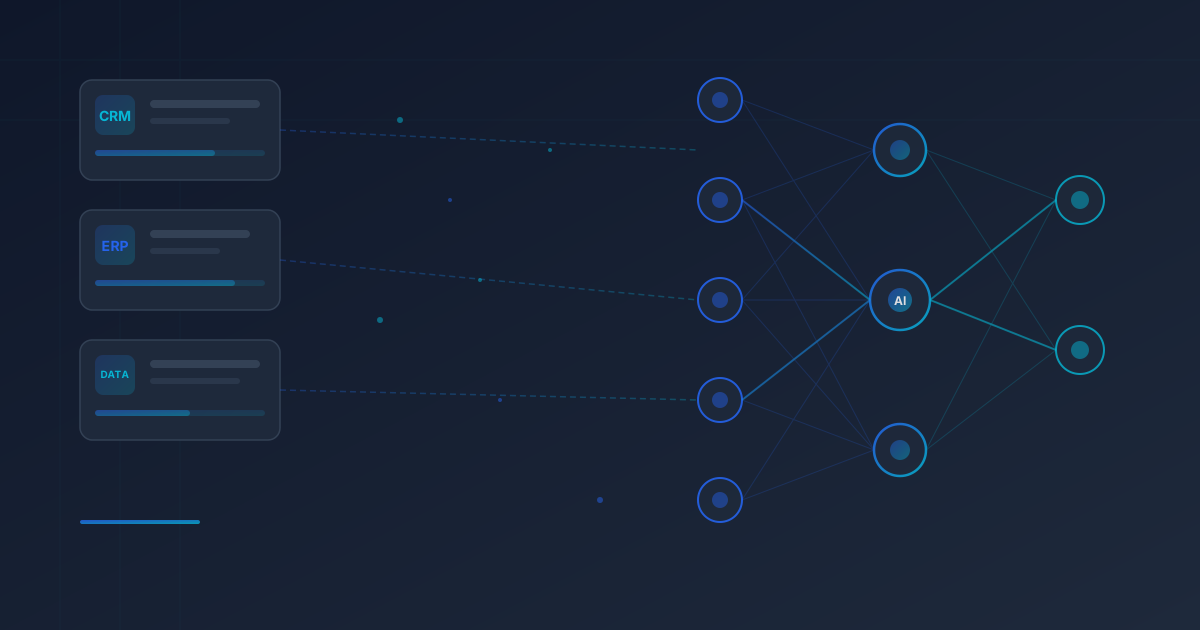
AI is only as good as the data it learns from. This phase involves consolidating data from disparate sources (CRM, ERP, spreadsheets, emails), cleaning and standardizing formats, resolving duplicates and inconsistencies and establishing data pipelines for ongoing collection. For many businesses, this is the most labor-intensive phase but also the most critical. Skipping proper data preparation is like building a house on sand.
- Deliverable: Unified, clean dataset ready for AI training
- Deliverable: Data governance policies and access controls
- Deliverable: Automated data pipeline architecture
Phase 3: Pilot Development (Weeks 6-12)
Start with one high-impact, lower-complexity use case. Build a minimum viable AI solution, whether that is a customer service chatbot trained on your FAQ and product data, an automated invoice processing workflow or a demand forecasting model for your top 100 products. Use existing platforms and APIs rather than building from scratch. The ChatGPT API, Claude API, or Gemini API combined with a lightweight integration layer can deliver production-ready results in weeks, not months.
- Deliverable: Working AI prototype deployed in a controlled environment
- Deliverable: Performance benchmarks (accuracy, speed, cost per transaction)
- Deliverable: User feedback from pilot group
Phase 4: Optimization and Scaling (Weeks 12-20)
Based on pilot results, refine the model. This typically means expanding training data, adjusting prompts or model parameters, improving edge case handling and integrating with additional internal systems. Once the pilot consistently meets performance targets, begin scaling: roll it out to additional departments, customer segments or geographies. Establish monitoring dashboards that track key metrics in real time and set up alerts for performance degradation.
- Deliverable: Optimized AI solution with documented performance improvements
- Deliverable: Scaling plan with resource requirements and timeline
- Deliverable: Monitoring and alerting infrastructure
Phase 5: Full Deployment and Continuous Improvement (Ongoing)
Deploy the AI solution across the organization with proper change management. Train all affected teams, update standard operating procedures and establish feedback loops so the AI continues to improve over time. Begin planning the next use case from your opportunity matrix. Companies that treat AI as an ongoing capability rather than a one-time project see 3-5x better long-term returns.
- Deliverable: Organization-wide deployment with full documentation
- Deliverable: Training materials and change management plan
- Deliverable: Quarterly review process for continuous optimization
Costs and ROI
AI implementation costs vary significantly based on scope, complexity and approach. Here is a realistic breakdown for 2026.
| Project Type | Investment Range | Typical ROI Timeline |
|---|---|---|
| AI Chatbot (API-based) | $5,000 - $25,000 | 2-4 months |
| Process Automation (IPA) | $20,000 - $100,000 | 3-8 months |
| Predictive Analytics Platform | $30,000 - $150,000 | 6-12 months |
| Custom AI Model (fine-tuned) | $50,000 - $300,000 | 6-14 months |
| Enterprise-wide AI Transformation | $200,000 - $1,000,000+ | 12-24 months |
The most important factor in ROI is not the size of the investment but how well it is targeted. A $10,000 chatbot deployed against a real customer service bottleneck will outperform a $500,000 analytics platform that solves a problem nobody has. Start with high-pain, high-frequency problems and expand from there.
Ongoing costs include API usage (typically $500-$5,000/month depending on volume), model monitoring and maintenance ($1,000-$5,000/month) and periodic retraining or optimization cycles. These costs are almost always a fraction of the value delivered.
Risks and Challenges
AI implementation is not without obstacles. Being aware of common pitfalls dramatically improves your chances of success.
- Data Quality Issues: Garbage in, garbage out. If your historical data contains errors, biases or gaps, the AI will amplify them. Invest in data cleaning before model development. Budget at least 30% of project time for data preparation.
- Unrealistic Expectations: AI is not magic. It will not solve organizational problems that are fundamentally process or people issues. Set measurable, realistic targets based on industry benchmarks rather than vendor marketing claims.
- Integration Complexity: Most businesses run on a patchwork of legacy systems, SaaS tools and manual spreadsheets. Connecting AI to these systems often takes longer than building the AI itself. Plan for API development, middleware and data synchronization challenges.
- Change Management: Employees may fear replacement or resist new workflows. Proactive communication, training and involving teams in the design process are critical. Frame AI as an augmentation tool that makes their jobs easier, not a replacement threat.
- Security and Privacy: AI systems that process customer data must comply with GDPR, CCPA and industry-specific regulations. Ensure data encryption, access controls, audit logging and clear data processing agreements with AI providers. Never send sensitive data to AI APIs without proper anonymization.
- Vendor Lock-in: Building your entire AI strategy around a single provider creates dependency risk. Use abstraction layers that allow switching between providers (e.g., build with the ChatGPT API but design the architecture so you can swap to Claude or an open-source model without rewriting your application).
- Hallucination and Accuracy: Large language models can generate plausible-sounding but incorrect information. For business-critical applications, always implement validation layers, human review checkpoints and retrieval-augmented generation (RAG) to ground AI responses in verified data.
Future Trends: What is Coming Next
The AI landscape is evolving rapidly. Here are the trends that will shape AI integration for business over the next 12-24 months.
- AI Agents: Autonomous agents that can plan, execute and iterate on multi-step tasks are already emerging in 2026. Expect AI that does not just answer questions but completes entire workflows: researching competitors, generating reports, scheduling meetings and following up, all without human prompting for each step.
- Multimodal AI: Models that seamlessly combine text, images, audio and video understanding will enable new use cases. Think quality inspection via smartphone camera, customer service that understands screenshots of error messages or meeting summaries generated from video calls.
- Edge AI: AI models running directly on devices (phones, IoT sensors, factory equipment) rather than in the cloud will reduce latency, improve privacy and enable offline operation. This is particularly relevant for manufacturing, logistics and healthcare.
- Industry-Specific Models: General-purpose models are being fine-tuned and specialized for specific industries. Medical AI models trained on clinical data, legal AI trained on case law and financial AI trained on market data will outperform generic models for their respective domains.
- AI Governance and Regulation: The EU AI Act is now in full enforcement. Businesses must classify their AI systems by risk level and comply with transparency, documentation and human oversight requirements. Companies that build compliance into their AI strategy from day one will have a significant advantage.
Conclusion
AI integration for business is not a future possibility. It is a present-day competitive advantage that separates growing companies from stagnating ones. The technology is mature, the tools are accessible and the implementation playbook is proven. What matters now is execution.
Start with a clear assessment of where AI can deliver the highest impact in your specific operations. Choose one use case, implement it properly, measure the results and scale from there. The companies that will lead their industries in the coming years are not the ones with the biggest AI budgets but the ones that move decisively, learn quickly and integrate AI as a core capability rather than a side project.
The best time to start your AI integration was a year ago. The second best time is today.
Related Articles
Ready to Integrate AI Into Your Business?
Let's discuss how AI can transform your operations — free initial consultation.
Schedule Free Call